Between the Honey and the Pickles: What a Month of Selling Art Next to the Zucchini Taught Me About Buyers
Photo: KhanEstes, CC BY-SA 4.0, via Wikimedia Commons
There's a certain humility that hits you around 6:45 on a Saturday morning when you're loading forty paintings into a Honda Civic while a guy two stalls over unloads forty pounds of heirloom tomatoes. Nobody at the farmers market cares that you once had a piece in a juried show. They care that you're blocking the honey vendor's light.
For the entire month of June, I traded my usual sales channels — the slow drip of Etsy orders, the occasional gallery consignment, the Instagram DMs that go nowhere — for a folding table between a raw honey stand and a pickle operation run by a woman named Doreen who became, unintentionally, my best sales coach.
Here's what happened.
Week One: Eating It
The first Saturday was a masterclass in failure. I set up the way I thought you were supposed to: prints displayed gallery-style, a small sign with my name, prices stickered neatly in the corner of each piece. I stood behind the table like a museum guard. I sold one print. To Doreen. Out of what I suspect was pity.
Total revenue: $18. Booth fee: $25.
I drove home doing the math on whether I'd rather lose money at a farmers market or lose money staying home, and honestly it was close. But I'd paid for four Saturdays up front, so quitting wasn't on the table. Literally — the table was already paid for.
The Contractors Showed Up in Week Two
Something shifted on the second weekend, and I didn't notice it until I tallied up sales that night. A roofing contractor bought a small landscape while his coffee was still steaming. An electrician grabbed two abstract pieces for his rebuilt kitchen. By the end of the month, I went back through my little notebook and counted: buyers who worked skilled trades out-purchased the self-identified art collectors and gallery hangers-on by a ratio of roughly four to one.
Why? A few theories, backed by four weeks of eavesdropping.
First, tradespeople are used to buying things based on whether they like them, not whether they're told to like them. Nobody haggles over a torque wrench because a critic called it "compelling." They pick up a painting, squint at it, say "huh, that'd look good over the mantel," and buy it. No credentials required.
Second, they haggle differently. Art people negotiate with language — "Is this piece part of a series?" — which is a polite way of asking why it costs $240. The contractor negotiating over a painting of the Blue Ridge at dusk negotiated the way you'd negotiate over lumber. Direct, quick, no hard feelings. "What'll you take for it, cash?" was the entire script. I said yes more often than I planned to, and I regret exactly zero of those deals.
Third — and this one surprised me — they commissioned work at a higher rate than any audience I've ever had. Turns out people who build things for a living respect people who make things. Three separate commissions came out of that table, including a large canvas of a 1968 F-100 that a diesel mechanic wanted for his garage. I'd never have painted a truck on my own. Now it might be my favorite thing I made all year.
What Flopped, Straight Up
Not everything worked, and I'd be lying if I pretended my instincts were good going in.
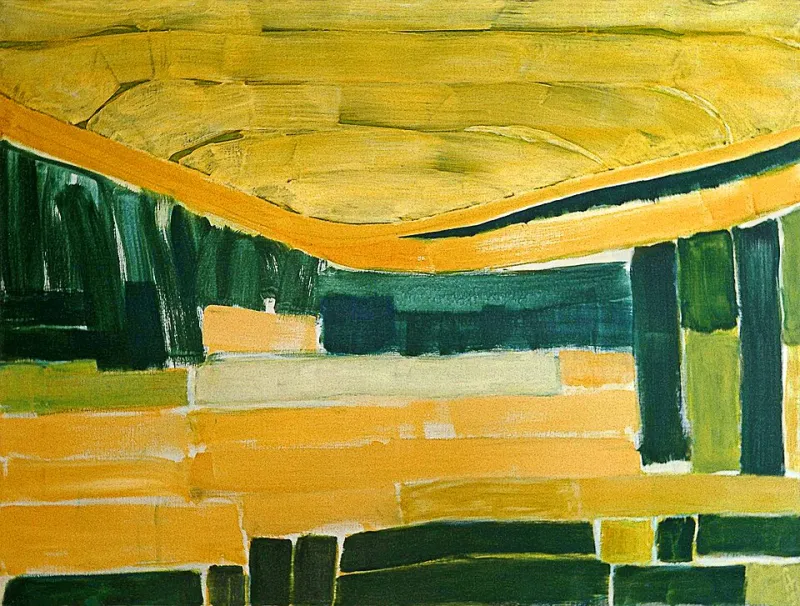
The small abstract pieces I'd been pushing on Instagram? Dead on arrival. Nobody at a farmers market wants to decode a mood. What moved instead were things with obvious subjects: the barn series, the lake at golden hour, a weirdly popular piece featuring a heron that I almost didn't bring because I thought it was boring.
Boring sells. Boring sells hard. A heron on a quiet river is not boring to the person who kayaks that exact river every Sunday. I was pricing my work against other art. They were pricing it against their own lives.
Also a flop: my careful little price stickers. People don't ask about prices they can see; they just walk away from ones they don't like. When I covered the table with a hand-lettered sign reading "EVERYTHING $20–$60, COMMISSIONS WELCOME," foot traffic doubled. The sign did the work. I just had to get out of the way.
The Sticker Gambit
Halfway through week two, desperate and overstocked, I printed a run of free stickers from one of my designs and started handing them to any kid who wandered past. Pure boredom move. Zero strategy.
By the following Saturday, kids were dragging their parents to my table by the hand. "That's the sticker guy!" One of those parents ordered a commissioned nursery piece. Another bought three prints. A third turned out to run a small restaurant twenty minutes away and now has my work on two walls.
Free stickers to children. That was the most effective marketing move of my creative career. I've spent actual money on worse ideas.
What I'm Keeping
I'm not selling my Etsy account or swearing off galleries. But the folding table isn't going anywhere either. Here's what the month changed permanently:
- I make work for people who live in houses, not people who write about houses.
- Clear subject matter is not selling out. It's a door, and doors are useful.
- The fastest way to find out if your art connects is to put it six feet from somebody eating a kettle corn.
- Tradespeople are the most underrated art-buying demographic in America, and every artist reading this should be at a market next Saturday taking their money.
Doreen, for the record, still has my print hanging in her pickle stall. She tells every customer an artist made it. That's worth more than any gallery label I've ever gotten.