When the Client Vanished, the Painting Got Better
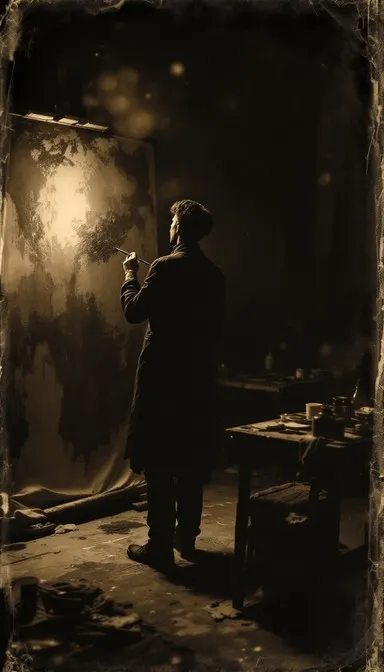
Photo: artist painting alone in studio at night moody lighting, via images.stockcake.com
It started the way most good commissions do: a friendly email, a deposit through Venmo, a Pinterest board with forty screenshots. The client—a small business owner from a suburb outside Austin—wanted a large abstract piece for her new office lobby. Warm tones, some texture, 'something that feels like ambition.' Her words. I liked her words.
I sketched. I primed. I painted through most of November with the space heater humming in my garage studio. And then, right around the 60% mark, the silence started.
The Slow Fade Every Creative Knows
First, she stopped replying to progress photos. Then an invoice reminder for the second payment sat unread for nine days. I gave it the standard grace period—people get busy, holidays happen, inboxes overflow. I sent one polite check-in. Then another two weeks later. Nothing.
By January, I had a 48-by-60-inch canvas leaning against my wall that nobody had asked for anymore, and a creeping bitterness I didn't want to admit to. I'd been ghosted by dates before. Getting ghosted by a client felt worse, because I'd already poured hours of craft into the relationship.
My first instinct was to gesso over the whole thing and move on. Salvage the canvas, eat the loss, add it to the mental file marked 'cost of doing business.' That file was getting thick.
The Pivot I Almost Didn't Make
But one night, staring at the thing while eating cold pizza, I noticed something. Free from the client's mood board, free from the phrase 'feels like ambition,' the painting was... almost interesting. The problem wasn't the work. The problem was that I'd been painting for an imaginary committee instead of for myself.
So I made a deal with the ghost: I'd finish it my way. I pushed the warm tones hotter, added a chaotic band of electric blue across the lower third that she never would have approved, and titled it something no corporate lobby would ever sanction. I called it 'Read at 11:47 PM,' because that's when the last unanswered email had come in.
Then I did the thing I'd been avoiding for years: I posted it for sale as an original. Not a commission inquiry. Not a 'message me for pricing.' A price. A listing. A statement.
What Happened Next
It sold in twelve days—to a buyer in Portland who said it 'reminded her of a decision she didn't regret.' I've thought about that sentence a lot.
Here's the part nobody tells you: that ghosted painting outsold every custom job I did that year. Not because it was better than my commissioned work—some of those clients got genuinely great pieces—but because it had a charge in it that client work rarely carries. There was frustration in the brushwork. There was an inside joke in the title. People could feel that a specific person made it, not a service provider.
I photographed it, shared the story of the ghosting (with zero identifying details, because I'm bitter, not unprofessional), and the post became the most engagement my page had ever seen. Three people inquired about buying 'something with that kind of energy.' Two of them became clients. Real ones, who pay on time.
The Rejection Was Redirecting Me
I used to read rejection as a verdict: the work wasn't wanted. Now I read it as routing. A client disappearing isn't a statement about your talent—it's usually a statement about their cash flow, their spouse's opinion, or their own avoidance issues. But the hours you already spent? Those are yours. The work in progress? Yours. The choice is whether you bury it or flip it.
Since then, I've built what I call the 'dead commission rule.' If a project sits unpaid and unanswered for 30 days, I get one email to close the loop. After that, the piece converts to personal inventory. I finish it however I want, I price it however I want, and I keep whatever it becomes. Every client contract I write now has a line about this—abandonment clauses, they're called. Boring paperwork that protects the fun stuff.
That painting still hangs where I can see it from my desk. It's a little ugly in places. It's also the most honest thing I made all year, and it only exists because someone stopped talking to me.
So if you're sitting on a half-finished piece for someone who's gone quiet: finish it for you. The ghost took a commission. Don't let them take the work too.